




Head of Online Medical Content

Audiology Expert & Founder of Hearing Aid UK
Why Are My Ears Blocked?
Causes, symptoms, and when to get help
Overview | What does it actually feel like? | The most common causes | When should you see a qualified audiologist? | Conclusion
Last Hearing Aid UK Update: 07
Overview
That muffled, underwater feeling in your ears is hard to ignore. Whether it comes and goes or has been lingering for weeks, blocked ears are among the most frequently reported ear complaints in the UK, and they are also one of the most frequently misunderstood.
The good news is that most cases of blocked ears are temporary and straightforward to address. The important thing is knowing when a blocked feeling might point to something worth investigating more carefully, including the possibility of hearing loss.
This article explains the most common causes of blocked ears, what the symptoms can tell you, when to see your local GP, and if a trip to an audiologist is needed after a referral.
What does it actually feel like?
The tricky thing about blocked ears is that the feeling is not always the same. Some people notice it straight away, others find it creeps up gradually. Here are some of the most common ways it tends to show up:
- A muffled quality to sounds, as though someone has turned the volume down
- A sensation of pressure or fullness in the ear
- Sounds feeling slightly distorted or echoey
- Your own voice sounding louder than usual when you speak
- Intermittent or persistent ringing in the ears (known as tinnitus)
- Difficulty following conversation, particularly in noisy environments
Blocked ears affect people of all ages, and most will experience them at some point in their lives.
The most common causes of blocked ears
Earwax build-up
Your ears actually do a pretty good job of looking after themselves. Earwax is part of that process. It is produced naturally to keep the ear canal clean, trapping dust, bacteria, and anything else that should not be in there.
For most people, the ear self-cleans without any help. However, some people produce more wax than usual, or use cotton buds in a way that pushes wax deeper into the canal, leading to a build-up that blocks sound from reaching the eardrum.
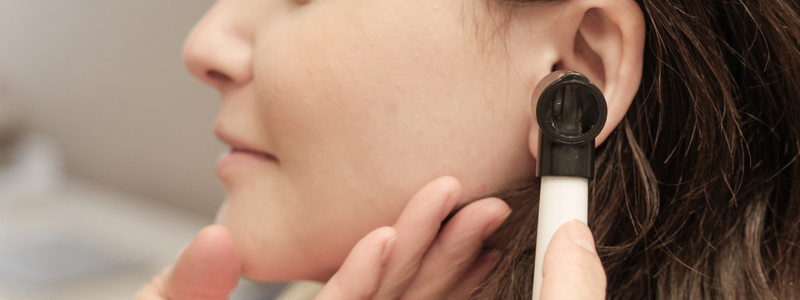
This is, according to NHS England, the single most common cause of blocked ears in adults and older adults, and it is entirely treatable. A qualified audiologist will be able to check for earwax using an otoscope (a small light used to look inside the ear canal) and can carry out earwax removal if needed.
Important: A quick word on cotton buds. Despite being marketed for ear cleaning, they are not designed to go inside the ear canal and can actually compact wax rather than clear it. Ear candles are similarly best avoided. Leave it to the professionals; it is a much kinder option for your ears.
Congestion and colds
Ever notice your ears getting blocked up when you have a cold? That is your Eustachian tube at work, or rather, not working quite as it should.
This small channel, which runs between your middle ear and the back of your throat, can swell up when you are congested, stopping air from circulating properly and leaving you with that familiar sensation of pressure or fullness.
Most of the time, it resolves on its own as the congestion eases. Steam inhalation and a decongestant spray can help things along. But if your ears are still feeling blocked two to three weeks after the cold has gone, it is worth having them checked.
Pressure changes
Have you ever noticed your ears blocking when you are in a plane, driving up a steep hill, or taking a lift in a tall building? This is caused by a sudden change in air pressure that the Eustachian tube cannot equalise quickly enough. Swallowing, yawning, or the Valsalva manoeuvre usually resolves this within a few minutes.
Swimmer's ear
Water trapped in the ear canal after swimming or bathing can cause a temporary muffled sensation. Tilting your head to one side and gently pulling the earlobe can encourage the water to drain. Persistent moisture in the ear canal can occasionally lead to an outer ear infection (otitis externa), which may need medical attention if it does not clear up quickly.
A perforated eardrum
If your blocked ear came on suddenly after a loud bang, a nasty ear infection, or some kind of knock or impact, it is worth considering whether your eardrum might be involved. A perforated eardrum, which is simply a small hole or tear in the eardrum itself, can cause muffled hearing, a sense of pressure, or a little discharge from the ear.
NHS guidance confirms that most perforated eardrums heal on their own within a few weeks. That said, it is always worth getting a proper look from a GP, so you know exactly what you are dealing with.
When blocked ears might signal hearing loss
This is the part that many people overlook. Not all blocked ear sensations are caused by something sitting in the ear canal. In some cases, the feeling that sounds are muffled or distant is actually an early indicator of hearing loss.
Age-related hearing loss (known as presbycusis) tends to develop gradually, which means many people initially interpret it as their ears simply feeling "off" rather than recognising it as a change in their hearing.
RNID research confirms that more than half of UK adults over 55 have some degree of hearing loss, and because it develops so gradually, the early warning signs are often easy to miss.
The same is true of noise-induced hearing loss, which can creep up over time without any obvious trigger. Some of the signals that a blocked feeling might be connected to hearing loss, rather than a temporary cause, include:
- The muffled sensation has been present for several months rather than a few days or weeks
- You have noticed that you are asking people to repeat themselves more often
- Following conversation in groups or in background noise has become harder
- You are turning the television up louder than you used to
If these experiences sound familiar, and your GP has ruled out other common causes, a hearing test is the most straightforward way to get a clear picture of what is happening. A hearing test is painless, takes around 30 to 45 minutes, and will produce an audiogram showing exactly which sounds and frequencies you are hearing clearly and which you are not.
"Blocked ears are one of the most common reasons people put off booking a hearing test. They get the wax checked, it's cleared, and they assume that's the end of it. But if the muffled feeling doesn't fully lift, or it keeps coming back, it's worth getting a referral from your GP to get your hearing properly assessed"
Paul Harrison, Audiology Expert & Founder, Hearing Aid UK
When should you see a qualified audiologist?
It is always worth seeking advice if:
- Your ears have felt blocked for more than two to three weeks with no obvious cause
- You have noticed any change in your hearing alongside the blocked feeling
- You have tinnitus (ringing, buzzing, or humming in the ears)
- You have any pain, discharge, or dizziness alongside the blockage
- You have already seen your GP and want a thorough hearing assessment
A qualified, HCPC-registered audiologist will begin any appointment by carrying out an otoscopic examination, checking for wax or any other visible issues in the ear canal, before moving on to a full hearing assessment.
This means that whatever is causing your blocked ears, you will come away with a proper explanation and a clear next step.
Key takeaways
✔️ Blocked ears are usually caused by something straightforward, such as earwax build-up, congestion, or a change in air pressure, and most cases clear up on their own or with simple treatment.
✔️ Cotton buds and ear candles tend to push wax further in rather than clear it, so they usually make things worse.
✔️ If a blocked feeling lasts more than two to three weeks, or brings pain, discharge, dizziness, or tinnitus, get it checked by a GP.
✔️ A persistent muffled sensation is sometimes an early sign of hearing loss rather than a physical blockage, particularly if it comes alongside asking people to repeat themselves or turning the TV up louder.
✔️ A free hearing test with an HCPC-registered audiologist includes an otoscopic examination as standard, so wax, infection, and hearing loss can all be ruled in or out during the same appointment.
Conclusion
Blocked ears are usually nothing to worry about, but they are worth taking seriously. Earwax, congestion, and pressure changes are the most common culprits, and most of these resolve with time or straightforward treatment.
What is worth bearing in mind is that a persistent muffled sensation, especially when it comes alongside difficulty following conversations or a change in how clearly you hear, can sometimes be an early sign of hearing loss. The sooner you get a proper assessment, the better your options and outcomes tend to be.
After you have been referred by your GP, a free hearing test with a qualified audiologist is the simplest first step. It takes less than an hour, involves no obligation, and could tell you everything you need to know.
Why Choose Us?
- FREE Hearing Tests
- Best Hearing Aids and Prices
- FREE Aftercare for Life
- FREE Home Visits
- FREE Clinic Appointments
- 200+ Local Audiologists
- 60 Day Money Back Guarantee
Not sure what is causing your blocked ears?
If your blocked ears have been bothering you and you're struggling to hear, after a referral from your GP, a free hearing test is the best place to start.
Our qualified, HCPC-registered audiologists are available across the UK, either at a clinic near you or in the comfort of your own home.
There is no charge, no commitment, and no pressure. Just clear, honest answers.
Book your free hearing test online or call us free on 0800 567 7621.

Other hearing loss awareness articles you might like...
 What is a Cholesteatoma?
  I need subtitles all the time
  Struggling to hear on public transport
What's included in our hearing aid prices?
Our specialist service includes:
Do not spend hundreds of pounds without getting a second opinion from us.
Please call us on 0800 567 7621
 Not only are the prices great, but the service is fantastic! Many thanks to your team.
Other pages you might find useful
Blocked ears: frequently asked questions
Can blocked ears cause temporary hearing loss?
Earwax build-up or congestion can leave your hearing sounding muffled for a while, but this usually clears up once the blockage does.
Is it safe to use cotton buds to clear blocked ears?
It's best avoided. Cotton buds tend to push wax further into the ear canal rather than clearing it, which often makes things worse.
How can I tell if my blocked ear is wax or something to do with my hearing?
The easiest way to know for sure is a free hearing test with an HCPC-registered audiologist, who can check for wax, infection, or hearing loss all in the same appointment.
Do I need a GP referral to get blocked ears checked privately?
Not at all. You can book a free hearing test directly with a qualified audiologist, either at your local clinic or with a free home visit, no GP referral needed.
How long should I wait before getting blocked ears checked?
If a blocked or muffled feeling lasts longer than two to three weeks, or comes with pain, discharge, or dizziness, it is worth having it checked by a GP or a qualified audiologist rather than waiting for it to pass.
Ask the Experts

Get free independent impartial advice from the experts you can trust. We offer nationwide coverage and huge savings on all our hearing aids.
6 Morton Lane
Walkwood
Redditch
Worcestershire
B97 5QA
Latest Launch
When we refer to a product as 'Latest Launch', we mean it is the latest to be released on the market.
New
When we refer to a product as 'New', we mean that the product is the newest hearing aid model on the market.
When we refer to a product as 'Superseded', we mean that there is a newer range available which replaces and improves on this product.
Older Model
When we refer to a product as an 'Older Model', we mean that it is has been superseded by at least two more recent hearing aid ranges.