




Head of Online Medical Content

Audiology Expert & Founder of Hearing Aid UK

The Latest Hearing Aid Technology in 2026
Predicting new developments in hearing aid technology
Hearing aid tech in 2026 | AI in hearing aids | Connectivity and biometrics | Design and stigma | Summary
Latest Hearing Aid UK Update: 08/07/2026
Overview
If you last looked into hearing aids a few years ago and came away feeling underwhelmed, it is worth looking again. The technology has moved on considerably, and not in the incremental, marginal way that technology often does. The hearing aids available in 2026 are genuinely different in kind from what was available even three years ago.
The change is being driven by a few things happening at once: artificial intelligence that has matured from a marketing term into a technology that actually works, connectivity standards that have finally caught up with what people expect from modern devices, and a quiet but steady shift in the way hearing aids are perceived by the people who wear them.
This article covers what the technology looks like right now, what it means in practice, and how to think about whether any of it matters for you.
What AI in hearing aids actually means in 2026
Artificial intelligence has been used as a selling point in hearing aids for several years now, and for much of that time, it was reasonable to be sceptical about how much difference it actually made. That has changed.
The current generation of AI processing works by training hearing aids on enormous libraries of real-world sound. Rather than applying a set of fixed rules to amplify certain frequencies and reduce others, the hearing aids have effectively learned to recognise the difference between speech and noise in the way a human brain does.
The result is that they can separate what you want to hear from what you do not, dynamically and in real time, in a way that earlier technology simply could not.
Phonak's Infinio Ultra platform, for example, uses a dedicated AI chip working alongside the main sound processing chip. Rather than having a single processor trying to do everything at once, the DEEPSONIC chip is entirely devoted to AI-powered speech clarity, working continuously in the background while you get on with your day.
Phonak states that the practical effect is meaningfully improved speech understanding in noisy environments compared to previous generations, though independent, peer-reviewed verification of this specific claim isn't yet available.
Starkey's Omega AI, launched in late 2025, takes a different approach. Their DNN 360 system processes sound from all directions simultaneously rather than focusing primarily on what is in front of you.
The idea is that conversations happen all around us, not just straight ahead, and hearing aids should reflect that. Their published research suggests up to 28% improved speech understanding in difficult listening conditions compared to their previous platform.
Oticon's Intent continues the BrainHearing philosophy that has always distinguished Oticon from other manufacturers: rather than deciding for you what to listen to, it gives your brain access to the full sound environment and supports the brain's own ability to make sense of it.
Their Deep Neural Network 2.0 has been trained on millions of real-world sound scenes, and the 4D sensor adds another layer of intelligence, detecting your head movements and activity to help the aids understand the context of what you are doing. In October 2025, Oticon updated the Intent with Bluetooth LE Audio, Google Fast Pair, and Auracast readiness.
"It's easy to assume the most advanced-sounding chip automatically means the best result for you. In practice, the right choice depends entirely on your hearing loss, your lifestyle, and how your ear canal is shaped, not on which manufacturer has the newest marketing term."
Paul Harrison, Audiology Expert and Founder at Hearing Aid UK.
Are AI hearing aids actually worth it?
For most people with mild to moderate hearing loss, the difference is noticeable. If you have tried hearing aids before and found them frustrating in noisy places, the improvement that current AI processing can make in those situations is one of the most compelling reasons to try again.
That said, AI is not a magic fix, and it is worth being clear-eyed about this. The technology is impressive, but it does not always get it right. Unpredictable environments can still catch it out, and the label "AI hearing aid" is now applied to devices at very different levels of sophistication.
There is no substitute for a proper assessment from a qualified audiologist who can match the right technology to your specific hearing loss, lifestyle, and budget.
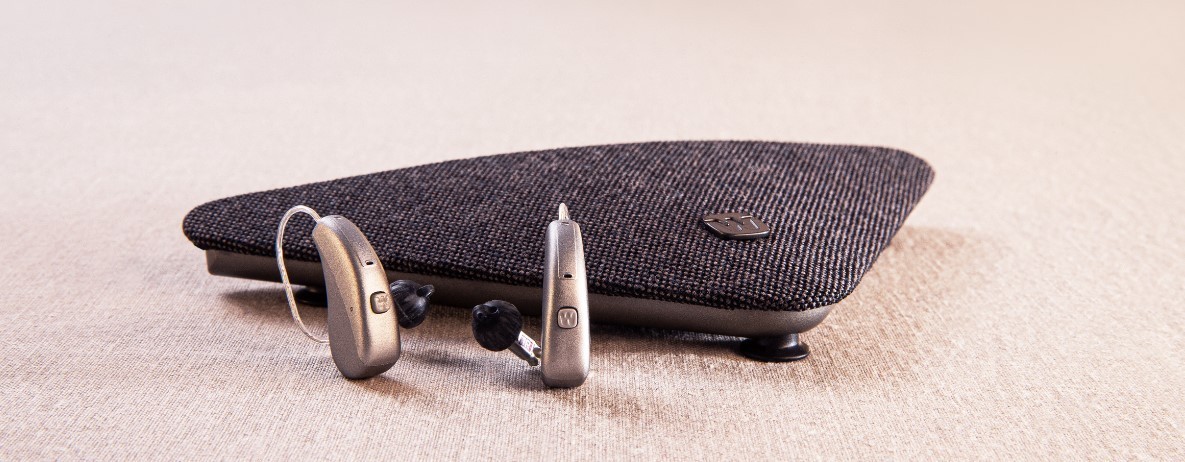
2026 Hearing Aid Technology
Bluetooth, Auracast, and biometrics
Connectivity: Bluetooth LE Audio and what it changes
Most modern hearing aids can connect to your smartphone. That has been true for several years. What has changed more recently is the quality and reliability of that connection, driven by a new standard called Bluetooth LE Audio.
Without going too deep into the technical details, Bluetooth LE Audio delivers better sound quality, uses less battery power to maintain the connection, and supports direct streaming to both ears simultaneously rather than routing through one hearing aid first. For people who stream calls, music, or television through their hearing aids, the difference is meaningful.
The connection is stable enough that it becomes something you actually use every day rather than a feature that sounds good on paper but frustrates in practice. Bluetooth LE Audio also enables Auracast, which is where the next significant development in public accessibility is heading.
Auracast: What it is and where it actually stands
Auracast is a broadcast audio technology that allows compatible hearing aids to connect directly to audio systems in public spaces, theatres, cinemas, airports, and other venues, receiving the sound directly rather than trying to pick it up from across the room. The Bluetooth SIG's Auracast page explains the full technical standard for anyone who wants to go deeper.
For anyone who has ever sat in a theatre and missed half the dialogue, or stood at a busy station trying to make out the announcements, the potential is obvious. Instead of straining to hear through background noise at a distance, the sound comes directly into your hearing aids, personalised to your hearing profile.
The honest picture is that Auracast is real, and a growing number of hearing aids now support it, including the updated Oticon Intent and recent Starkey and Resound models. The limitation is still venue adoption.
The technology only works if the venue has installed a compatible transmitter, and while that rollout is underway, it is gradual. You are more likely to encounter it in newly built or recently refurbished venues than in older ones, at least for now.
This is not a reason to dismiss it. It is simply worth knowing that Auracast is genuinely arriving rather than remaining a future promise, but that its real-world impact will build over the next few years rather than being immediately available everywhere you go.
Health monitoring: beyond just hearing
One of the more interesting directions hearing aid technology has taken is the expansion into health monitoring. Hearing aids are worn in the ear for most of the day, which makes them well-placed to track certain health metrics continuously in a way that a wrist-worn device cannot.
Starkey's Omega AI is the furthest ahead here. Starkey states that the device tracks activity levels, includes a balance assessment tool, and monitors respiratory patterns, building a picture of overall well-being alongside hearing performance. Their companion app correlates this data to give users a more complete picture of how their hearing aids and their health are working together.
This is not yet at the level of clinical-grade medical monitoring, and it should not be treated as a substitute for any form of medical assessment. But as an additional layer of insight about how you are moving, resting, and functioning day to day, it is a genuinely interesting development, and one that is likely to become more sophisticated over the next few years.
What's new in hearing aid technology for 2026?
Design, size, and stigma
Design: smaller, better, and increasingly sustainable
One of the quieter revolutions in hearing aids is happening in the physical design. The devices being fitted today are, in many cases, considerably smaller and more discreet than anything available five years ago, while simultaneously offering more processing power and longer battery life.
Rechargeable designs have become the standard rather than the exception across most premium models, with most delivering a full day of use from a single overnight charge. Cases have also become more portable and practical. For anyone who found the fiddliness of tiny disposable batteries a deterrent in the past, that barrier is largely gone.
There is also a growing focus on sustainability. More manufacturers are using recycled materials, reducing packaging, and designing devices with longer service lives. For consumers who think about environmental impact, it is worth asking about this when you speak to your audiologist.
The stigma shift
Perhaps the most significant change is not in the technology at all but in the culture around it. Hearing aids are becoming, gradually and genuinely, less associated with age and decline and more associated with taking care of yourself.
Consumer technology has played a part in this. The arrival of features in mainstream earbuds that overlap with hearing support has normalised the idea of wearing something in your ear.
RNID research published in September 2024 found that 47% of people still believe hearing aids carry a social stigma that glasses do not, and 11% said they would rather live with hearing loss than wear aids.
Those are still sobering figures. But they are moving in the right direction, and the technology itself, with its increasingly discreet designs and genuinely impressive performance, is part of what is driving that change.
Summary
Hearing aid technology in 2026 is the best it has ever been. AI processing that genuinely works in noisy environments, connectivity that is stable and useful, Auracast beginning to arrive in real venues, health monitoring expanding beyond hearing, and designs that are smaller and more sustainable than anything that came before.
None of this means that any hearing aid will work brilliantly for everyone straight out of the box. The technology matters, but the fitting matters at least as much. A well-fitted hearing aid at mid-range technology will usually outperform a poorly-fitted premium one.
That is why the relationship with a qualified audiologist remains the most important part of the process, regardless of how impressive the technology has become.
If you have been putting off addressing your hearing, the honest answer is that what is available right now is genuinely worth your time to explore. If you would like to see how the best hearing aids compare across brands, or explore the full range of hearing aid types available, our help centre has everything you need.
Why Choose Us?
- FREE Hearing Tests
- Best Hearing Aids and Prices
- FREE Aftercare for Life
- FREE Home Visits
- FREE Clinic Appointments
- 200+ Local Audiologists
- 60 Day Money Back Guarantee
Ready to explore what current hearing aid technology could do for you?
The best hearing aid isn't the one with the newest AI chip; it's the one properly fitted to how you actually hear and live. Speak to one of our independent, HCPC-registered audiologists for honest, impartial advice.
The test is free, the advice is impartial, and there is no obligation to buy anything.
Call us free on 0800 567 7621, or book your free hearing test at a local clinic or in your own home.

Other hearing aid technology articles you might like...
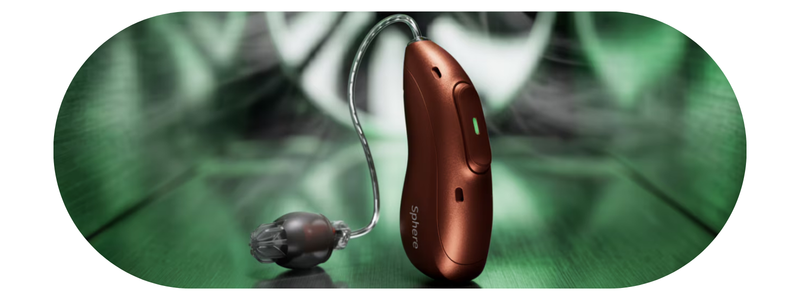 Phonak EON Sphere vs Phonak Infinio Ultra Sphere
  Phonak Infinio Ultra Sphere i90 vs Unitron Smile Moxi RX 9
  Rugged Hearing Aids
 Our specialist service includes:
Do not spend hundreds of pounds without getting a second opinion from us.
Please call us on 0800 567 7621
 Not only are the prices great, but the service is fantastic! Many thanks to your team.
What's included in our hearing aid prices?
Other pages you might find useful
Common FAQs when researching hearing aids and hearing loss
In general, any audiologist will always recommend to you the hearing aid model that best suits your needs. Here is a useful checklist to make sure that is the case.
- Audiologist's level of knowledge: The audiologist you have seen will hopefully have a wide knowledge of all available hearing aids; however, some will only be familiar with a small number of brands and, therefore, may not really be in a position to know which model is the best for you. It is OK to challenge their recommendation and ask them to justify why this particular brand is the one for you.
- Do research: Read about the hearing aid that was recommended. Does it seem like it will suit your lifestyle? Does it have more or fewer features than you need?
- Be aware of sales targets: Many high street retailers have specific tie-ins to a particular manufacturer/brand. The hearing aid they have suggested may still be the correct one for you, but do your research so that you know why they might have recommended it. You can read our best hearing aids of this year here
If you have significant hearing loss in both ears, you should be wearing two hearing aids. Here are the audiological reasons why:
Localisation: The brain decodes information from both ears and compares and contrasts them. By analysing the minuscule time delays as well as the difference in the loudness of each sound reaching the ears, the person is able to accurately locate a sound source.
Simply put, if you have better hearing on one side than the other, you can't accurately tell what direction sounds are coming from.
Less amplification is required: A phenomenon known as “binaural summation” means that the hearing aids can be set at a lower and more natural volume setting than if you wore only one hearing aid.
Head shadow effect: High frequencies, the part of your hearing that gives clarity and meaning to speech sounds, cannot bend around your head. Only low frequencies can. Therefore, if someone is talking on your unaided side, you are likely to hear that they are speaking, but be unable to tell what they have said.
Noise reduction: The brain has its own built-in noise reduction, which is only really effective when it is receiving information from both ears. If only one ear is aided, even with the best hearing aid in the world, it will be difficult for you to hear in background noise as your brain is trying to retain all of the sounds (including background noise) rather than filtering them out.
Sound quality: We are designed to hear in stereo. Only hearing from one side sounds a lot less natural to us.
Fancy some further reading on this topic? You can read about why two hearing aids are better than one in our article, hearing aids for Both Ears, here
For most people, the main benefit of a rechargeable hearing aid is simple convenience. We are used to plugging in our phones and other devices overnight for them to charge up. Here are some other pros and cons:
For anybody with poor dexterity or issues with their fingers, having a rechargeable aid makes a huge difference, as normal hearing aid batteries are quite small and some people find them fiddly to change.
One downside is that if you forget to charge your hearing aid, then it is a problem that can't be instantly fixed. For most, a 30-minute charge will get you at least two or three hours of hearing, but if you are the type of person who is likely to forget to plug them in regularly, then you're probably better off with standard batteries.
Rechargeable aids are also a little bit bigger and are only available in Behind-the-Ear models.
Finally, just like with a mobile phone, the amount of charge you get on day one is not going to be the same as you get a few years down the line. Be sure to ask what the policy is with the manufacturer's warranty when it comes to replacing the battery.
For most people, the answer is yes. But it's never that simple.
The majority of hearing problems affect the high frequencies a lot more than the low ones. Therefore, open fitting hearing aids sound a lot more natural and ones that block your ears up can make your own voice sound like you are talking with your head in a bucket. Therefore, in-ear aids tend to be less natural.
However, the true answer is we can't tell until we have had a look in your ears to assess the size of your ear canal, and until we have tested your hearing to see which frequencies are being affected.
People with wider ear canals tend to have more flexibility, also there are open fitting modular CIC hearing aids now that do not block your ears.
There is also the age-old rule to consider, that a hearing aid will not help you if it's sat in the drawer gathering dust. If the only hearing aid you would be happy wearing is one that people can't see, then that's what you should get.
Most people can adapt to any type of hearing aid, as long as they know what to expect. Have an honest conversation with your audiologist as to what your needs are.
Generally speaking, six or more. Unless it's none at all. The number of channels a hearing aid has is often a simplistic way an audiologist will use to explain why one hearing aid is better than another, but channels are complex, and it is really not that straightforward. Here are some reasons why:
Hearing aids amplify sounds of different frequencies by different amounts. Most people have lost more high frequencies than low, and therefore need more amplification in the high frequencies. The range of sounds you hear is split into frequency bands or channels, and the hearing aids are set to provide the right amount of hearing at each frequency level.
Less than six channels, and this cannot be done with much accuracy, so six is the magic number. However, a six-channel aid is typically very basic with few other features and is suitable only for hearing a single speaker in a quiet room. The number of channels is not what you should be looking at; it's more the rest of the technology that comes with them.
As a final note, different manufacturers have different approaches. One method is not necessarily better than any other. For example, some manufacturers have as many as 64 channels in their top aids. Most tend to have between 17 and 20. One manufacturer has no channels at all.
Manufacturer's warranties typically last between 2-5 years, depending on the brand and model, and cover defects in materials and workmanship. This includes repairs for component failures, electronic malfunctions, and manufacturing defects, but excludes damage from misuse, accidents, or normal wear. Most manufacturers also include loss and damage insurance for the first year.
We handle all warranty claims on your behalf, liaising with manufacturers and ensuring you get replacement devices quickly when needed. This comprehensive warranty coverage, combined with our lifetime aftercare, gives you complete peace of mind. Find out more about our warranty cover here
Our hearing tests are completely free, whether at our clinics or in your home. Unlike other providers who charge £30-£100 for home visits, we believe hearing healthcare should be accessible without financial barriers. Our comprehensive assessments include examination by an HCPC-registered audiologist, audiogram results, and personalised recommendations.
All testing, future adjustments, and ongoing support are included at no extra cost. While NHS tests are also free, typical 6-week waiting periods often lead people to seek immediate private testing. We provide prompt, professional assessments that fit your schedule and budget.
Yes, we offer completely free home visits throughout the UK, and this service is included in our prices with no additional charges. Home visits are particularly valuable for people with mobility issues, busy schedules, or those who simply prefer the comfort and convenience of their own environment.
Our audiologists can conduct full hearing tests, fit hearing aids, and provide ongoing support in your home. This service sets us apart from many providers who either don't offer home visits or charge extra for them.
We can offer prices up to 40% lower than high street retailers because of our business model. As a network of 200+ independent audiologists, we don't have the massive overheads of large retail chains - no expensive high street premises, no sales targets pushing audiologists to sell the most expensive options, and no costly marketing campaigns.
However, we maintain the same buying power as the big chains because we purchase on behalf of our entire nationwide network. This means you get access to the same premium hearing aids with professional service, but at genuinely competitive prices.
We offer a comprehensive 60-day money-back guarantee, which gives you twice the industry standard time to properly assess whether your hearing aids are right for you. This extended period recognises that adjusting to hearing aids takes time, and your brain needs several weeks to adapt to the amplified sounds.
Unlike many providers who offer just 30 days, we believe 60 days gives you the confidence to test your hearing aids in all the situations that matter to you - from quiet conversations at home to busy restaurants and outdoor activities.
Ask the Experts

Get free independent impartial advice from the experts you can trust. We offer nationwide coverage and huge savings on all our hearing aids.
6 Morton Lane
Walkwood
Redditch
Worcestershire
B97 5QA
Latest Launch
When we refer to a product as 'Latest Launch', we mean it is the latest to be released on the market.
New
When we refer to a product as 'New', we mean that the product is the newest hearing aid model on the market.
When we refer to a product as 'Superseded', we mean that there is a newer range available which replaces and improves on this product.
Older Model
When we refer to a product as an 'Older Model', we mean that it is has been superseded by at least two more recent hearing aid ranges.